
Business positioning strategy is essential for brands that want to stand out in a crowded market and attract the right customers consistently. When positioning is unclear, businesses struggle with differentiation, pricing pressure, and weak customer trust.
In competitive industries, customers don’t compare every option in detail. They choose the brand that communicates clarity, relevance, and value the fastest.
Table of Contents
- What Is a Business Positioning Strategy?
- Why Positioning Matters in a Crowded Market
- Core Elements of Strong Positioning
- 7 Powerful Ways to Build Your Positioning Strategy
- Real-World Positioning Examples
- Common Mistakes to Avoid
- Final Takeaway
What Is a Business Positioning Strategy?
A business positioning strategy defines how your brand is perceived in the minds of your target audience. It explains who you serve, what problem you solve, and why your solution is different from competitors.
Instead of competing only on features or price, strong positioning focuses on relevance, clarity, and perceived value.
Why a Business Positioning Strategy Matters in a Crowded Market
In saturated markets, many businesses sound the same. Similar messaging and similar offers create confusion, making it difficult for customers to decide.
Without clear positioning, businesses often face:
- Low conversion rates
- Weak brand recall
- Price-based competition
- Longer sales cycles
- Customer confusion
A strong business positioning strategy removes uncertainty and gives customers a clear reason to choose your brand.
Core Elements of a Strong Business Positioning Strategy
Clear Target Audience
Effective positioning starts with focus. When you clearly define who your ideal customer is, your messaging becomes more relevant and compelling.
Specific Problem Definition
Your positioning should clearly address one primary problem your audience wants solved urgently.
Unique Value Proposition
This explains how your solution is different or better in a way that matters to customers.
7 Powerful Ways to Build a Business Positioning Strategy
1. Narrow Your Focus
Strong positioning comes from specialization. Focus on one core solution and one audience segment.
2. Speak the Customer’s Language
Use the exact words your customers use to describe their problems and goals.
3. Lead With Outcomes
Position your offer around results and transformation, not just features.
4. Be Consistent Across Channels
Your website, ads, content, and sales conversations should reinforce the same positioning message.
5. Build Authority Through Content
Educational content strengthens your business positioning strategy by building trust and expertise.
6. Use Social Proof
Testimonials and case studies validate your positioning and reduce buyer hesitation.
7. Test and Refine Regularly
Monitor engagement and conversions to improve your positioning over time.
Real-World Examples of Business Positioning Strategy
Many successful brands dominate competitive markets because of clarity, not larger budgets.
Examples include:
- Agencies offering one specialized service
- Coaches selling a single transformation program
- Brands focused on one flagship product
According to insights shared by Harvard Business Review, brands with clear positioning outperform competitors in crowded industries.
Internal Insight
Explore more strategic marketing concepts in our business growth blog, where we share practical insights for long-term success.
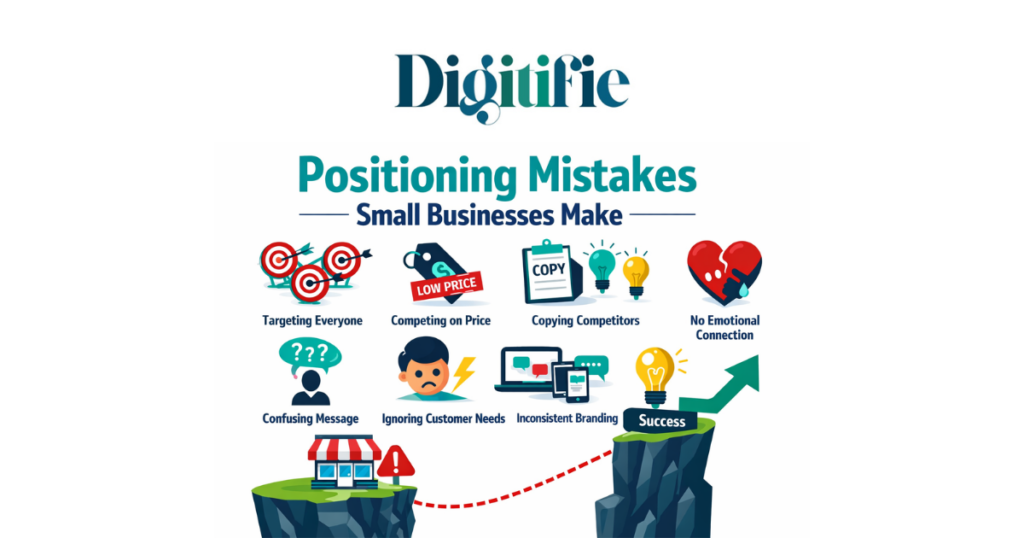
Common Mistakes to Avoid
- Trying to appeal to everyone
- Competing only on price
- Copying competitor messaging
- Changing positioning too frequently
Final Takeaway: Why Positioning Determines Success
A clear business positioning strategy makes your brand easier to understand, easier to remember, and easier to choose. In crowded markets, clarity is the strongest competitive advantage.
When positioning is intentional and consistent, marketing becomes simpler and growth becomes more predictable.